A report written by Giuseppe Dante Tamborrino:
Never would I have imagined that one day I would play electronic music live, as an orchestral instrument, in a classical chamber opera, with a choir; they are two worlds, and yet, here I am.
First, some background. I come from a family of percussionists and composers, each with his own ideas and musical styles. It’s not always easy to agree on musical choices. But recently, my father composed two new works, one for a small percussion group and another for orchestra and choir. And, somewhat unexpectedly, he invited me to become part of the ensemble, reminding me that events, shows and concerts, are born freely, from experimentation. He gave me one directive: “Explore!”
I knew the first event had a semi-graphical score which would allow me the latitude to employ a personal sonic language based on recycled percussions, vases, etc. But I was still struggling with finding a way to sonically bridge the two worlds: traditional chamber opera and my improvisatory world of live electronics.
First Rehearsal
I took my Pacamara to the first test and set up the live electronics on the same day: two battery and bluetooth speakers, a small sound card with 2 input channels and 4 output channels (2 channels in headphones and 2 channels at the speakers, so I could preview the experimental constructions based above on the microphone input, treated by the sound synthesis in Kyma). My goal was to blend Kyma with the timbres, rhythms, and the acoustic sound density of the instruments, trying to respect the roles of the other instruments, so as not to cover them, alternating reiterations of the existing sound with spectral treatments; pitch shift, delay, vocoder and manual modulation of the window size.
At one point during rehearsals, my father (who was conducting) suddenly looked up and said to the musicians, “Yes! That’s the sound I’m looking for!” To which the musicians replied, “That’s not us—that’s your son!” The sound quality of the electronics was so good and so seamlessly blended that it could be confused with the original acoustic instruments; during the performance it was not clear which magical instrument was playing. At that moment, the ‘two worlds’ I feared were irreconcilable had suddenly become one.
Day 1
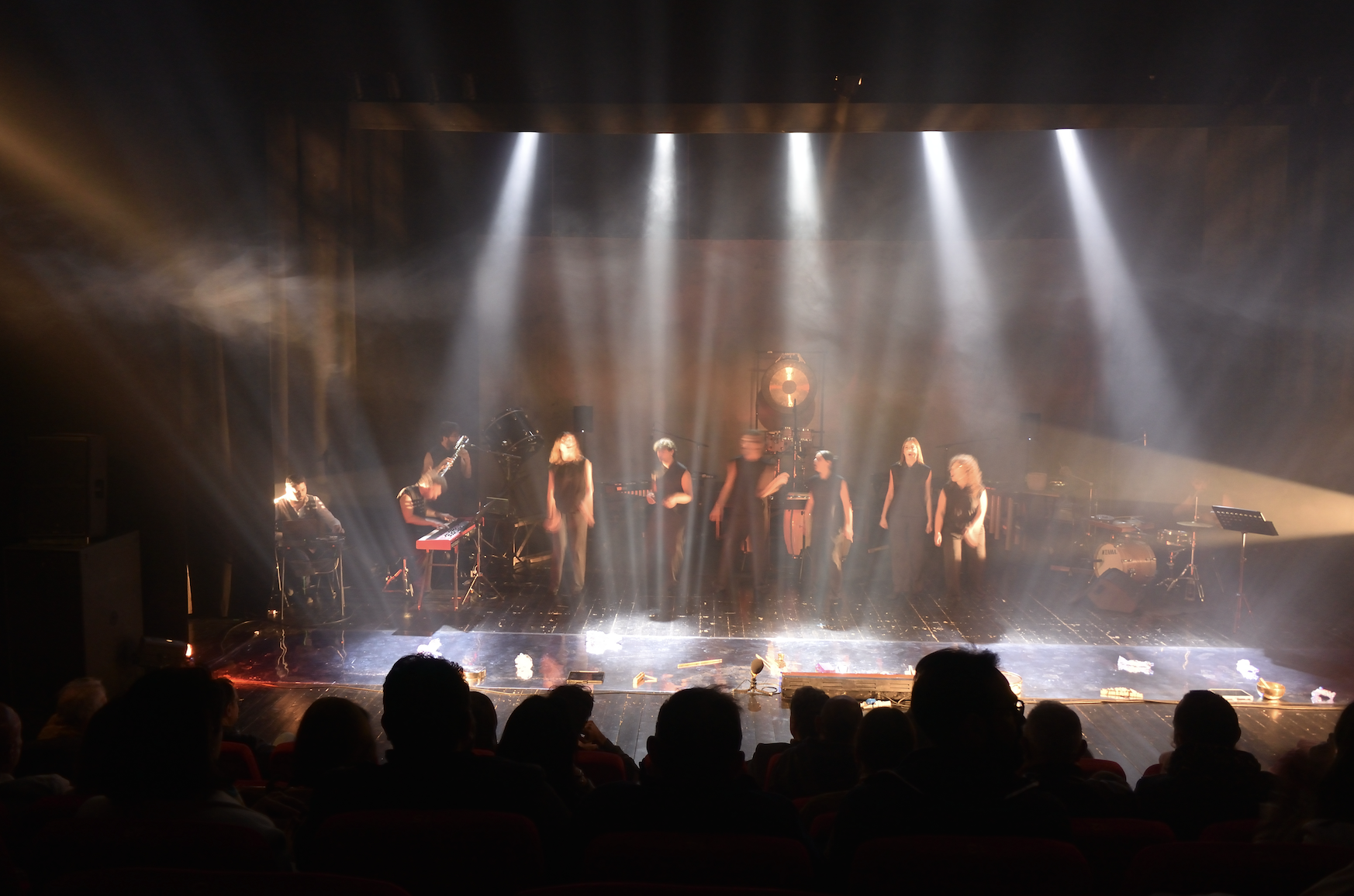
The world premiere of La Follia Delle Folle, an opera commissioned by Human Ensemble with music by Giovanni Tamborrino and lighting by Michelangelo Campanale took place on 23 April 2026 at the Ruvo Municipal Theater in the province of Bari. This experimental work explores the intersection of media and social provocation and is intended to shine a light on several episodes that have marked our time. It was part of the four-day ESSERE festival put on by Human Ensemble to create an inclusive, participatory space where art, music, and ideas intertwine.
La Follia Delle Folle is a work for contemporary ensembles: percussion, vocals, bass flute, electronic keyboards and sound objects: plastic bottles, vases, marble slabs, small bells and more. The entire concert is based on a contemporary score with a musical and narrative design comprising micro and macro events in which jazz and fusion influence small events—(micro) rhythms and melodies—that combine into (macro) structures, navigating various genres and styles, from the classic to the more accessible styles, all ultimately transformed through electronics.
The electronic instrumentation was based on feedback and MemoryWriters, to establish a melodic and rhythmic connection. I divided the instrumentation for live electronics into two parts to impart more energy and variation throughout:
• Texturing Instruments for slow parts from 68 to 112 bpm, based on granular synthesis with slow buffer reading, pitch shift for octaves and fifths, reiterated by the captured signal Mic → evolved → sent with my speakers and back. A kind of feedback synthesis to contribute to the final acoustic body to the depth of the melodic and slow parts.
• Rhythm Instruments for fast and rhythmic parts from 112 to 178 bpm; strong delays with pitch shift and scratching with variable size of the table by adding accelerations and decelerations of the sound stored with recursive input, to the density of the rhythms with percussions and orchestra.
In this Rhythmic section I also used a small box with a piezo, springs and a small rope, to send very short and clear sounds to the Pacamara, easily perceivable and rhythmic impulses into the evolving sound. This allowed me to clean and reduce the sound mass in very dense areas and to avoid covering fundamental rhythms in the score.
Lights and scenography contributed to the listening immersion and enhanced the meaning of the performance.
Power On
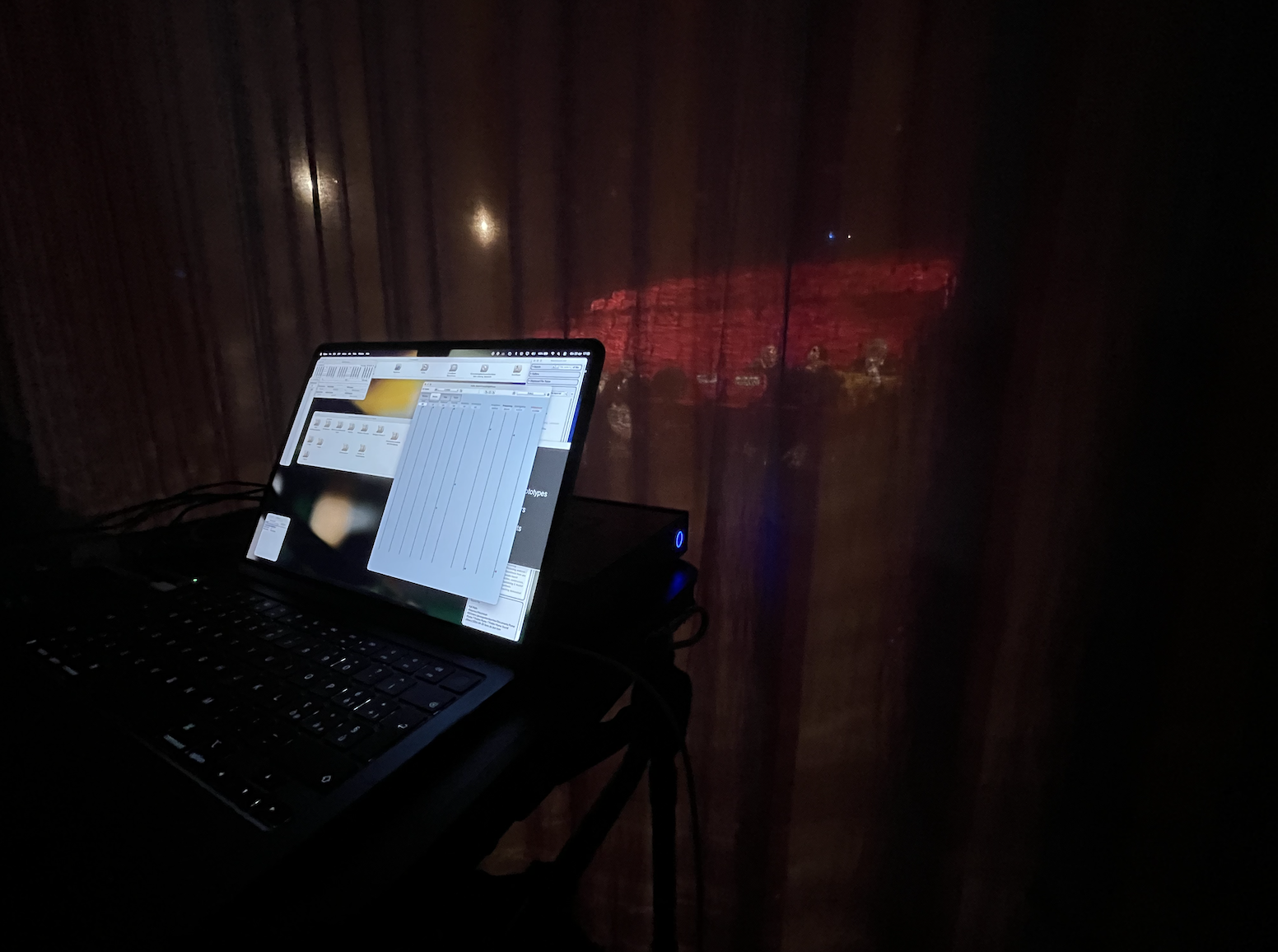
At Power On, for the first time in my life, I felt a sense of computer security and stability, which totally erased the sense of panic I’d always experienced before each of my pre-Kyma concerts.
Day 2
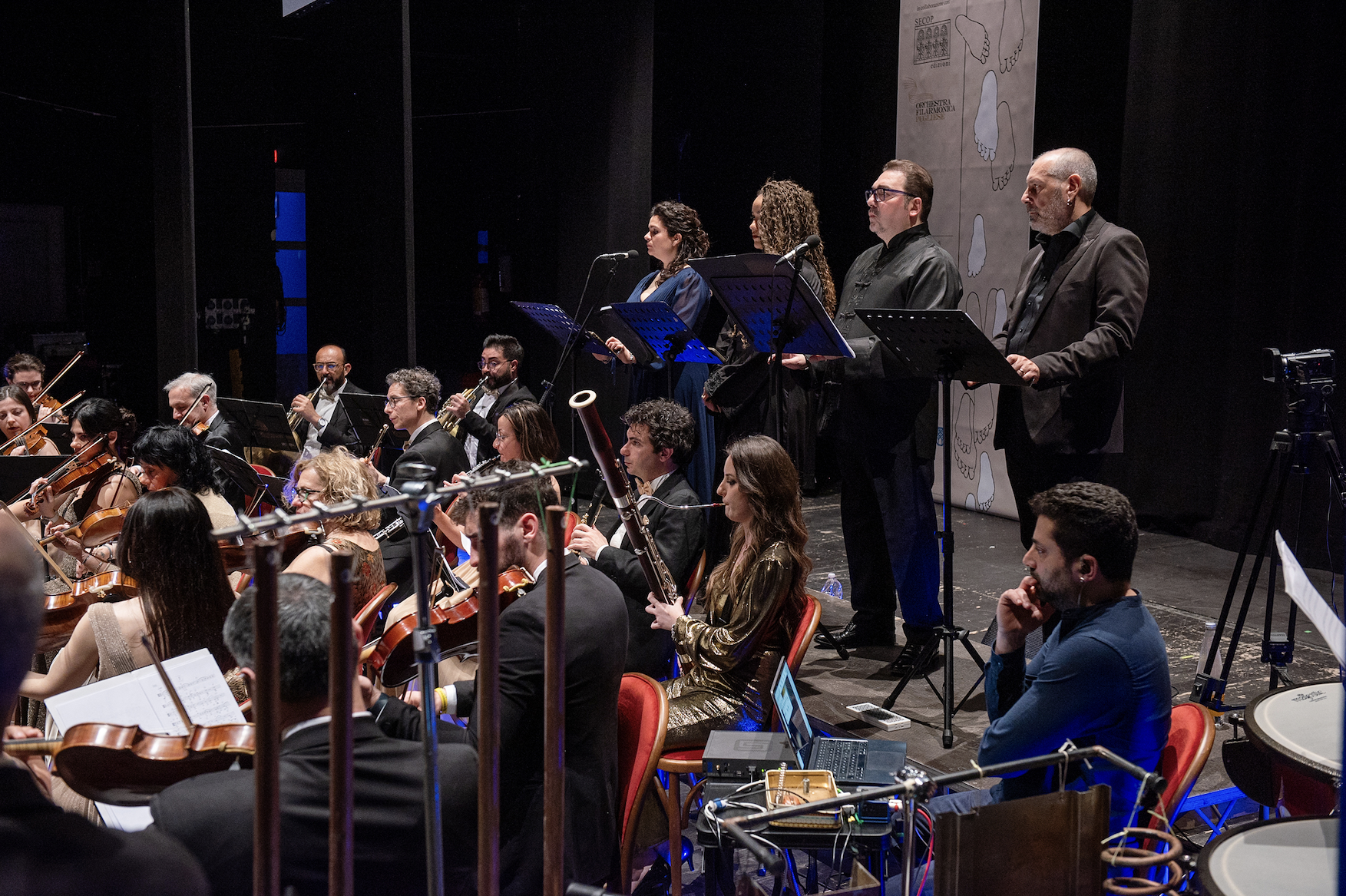
ShalomPaxSalam, the chamber opera by Giovanni Tamborrino with libretto by Enzo Quarto, had its world premiere at Bari’s Teatro Piccinni, featuring the Orchestra Filarmonica Pugliese. The title ShalomPaxSalam communicates the “three worlds” of the Abrahamic faiths coming together through the shared word for “Peace” and explores the theme of interfaith unity and the reconciliation of conflict—a message that feels particularly urgent in our times. (News article and Poster)

I wanted to expand the musical sound possibilities, looking for a connection between the sound of the orchestra and a soundscape of natural events described in the text that deals with the land of Canaan and other places, to better communicate the narrative of the opera. In this work in fact, I dealt more with sound design, using simple generators of filtered white and pink noise to create a kind of performable ‘synthetic sea’—a controllable, perceiveable instrument superimposed over a great orchestral sound density.
Following a similar approach to the day before, I divided my contributions—though they were less prominent this time—into two sections: slow and fast. For the slow parts I used tools, such as recursive samplers with loopback, to automatically attenuate loud signals to emphasize the softer signals. This created a threshold within the orchestral space, where I used spatial movement and spectral recurrences to ‘read’ the incoming audio at an extremely slow rate. By re-processing the accumulated acoustic signal—varying from zero to four seconds of captured sound—I was able to generate complex morphologies and refractions of the orchestra’s own voice.
For the fast parts I used vocoders and pitch shifters together with my small box of recycled instruments taken from the piezo, looking for background effects and thin sounds, as metaphors for insects and sand, to accompany staccato sounds of flutes and percussion.
The entire performance was the result of a magnificent orchestral performance of the Orchestra Filarmonica Pugliese which alternated moments of classical and sacred music with moments of electronic music to combine past and present in a single work.