Yasuski has turned his MotorMix into a wireless Kyma controller using an XBee radio module.
Official organ of the Symbolic Sound Corporation

SoundProof (Patricia Strange, violin; Stephen Ruppenthal, trumpet, flugelhorn, & voice; Brian Belet, viola, voice, and Kyma processing) have just embarked on a multi-city tour of the midwest culminating in the opening concert for the EMM festival on October 11 2012.
EMM will also feature the world premiere of Belet’s new percussion/Kyma composition on Saturday October 13 and a performance of Hua Sun’s Impression of Tibet for Wacom Tablet controlling Kyma on October 12.
The full SoundProof concert schedule includes:
Monday, October 1st: Bowling Green State University (Bryan Recital Hall, Moore Musical Arts Center), 8pm
Thursday, October 4th: College-Conservatory of Music, University of Cincinnati (Watson Recital Hall, Corbett Center), 8pm
Tuesday, October 9th: Ohio University, Athens (Recital Hall – Gldn 400, School of Music), 8pm
Thursday, October 11th: Electronic Music Midwest festival – opening concert (Lewis University, Romeoville, IL), 7:30 pm
The concerts feature interactive Kyma pieces composed specifically for the ensemble by Brian Belet, Bruno Liberda, Stephen Ruppenthal, Jeffrey Stolet. Each concert also includes a ’15 Minutes of Fame’ set featuring one-minute works by 15 composers including Brian Belet, Mark Phillips, Scott Miller, and Michael Wittgraf.
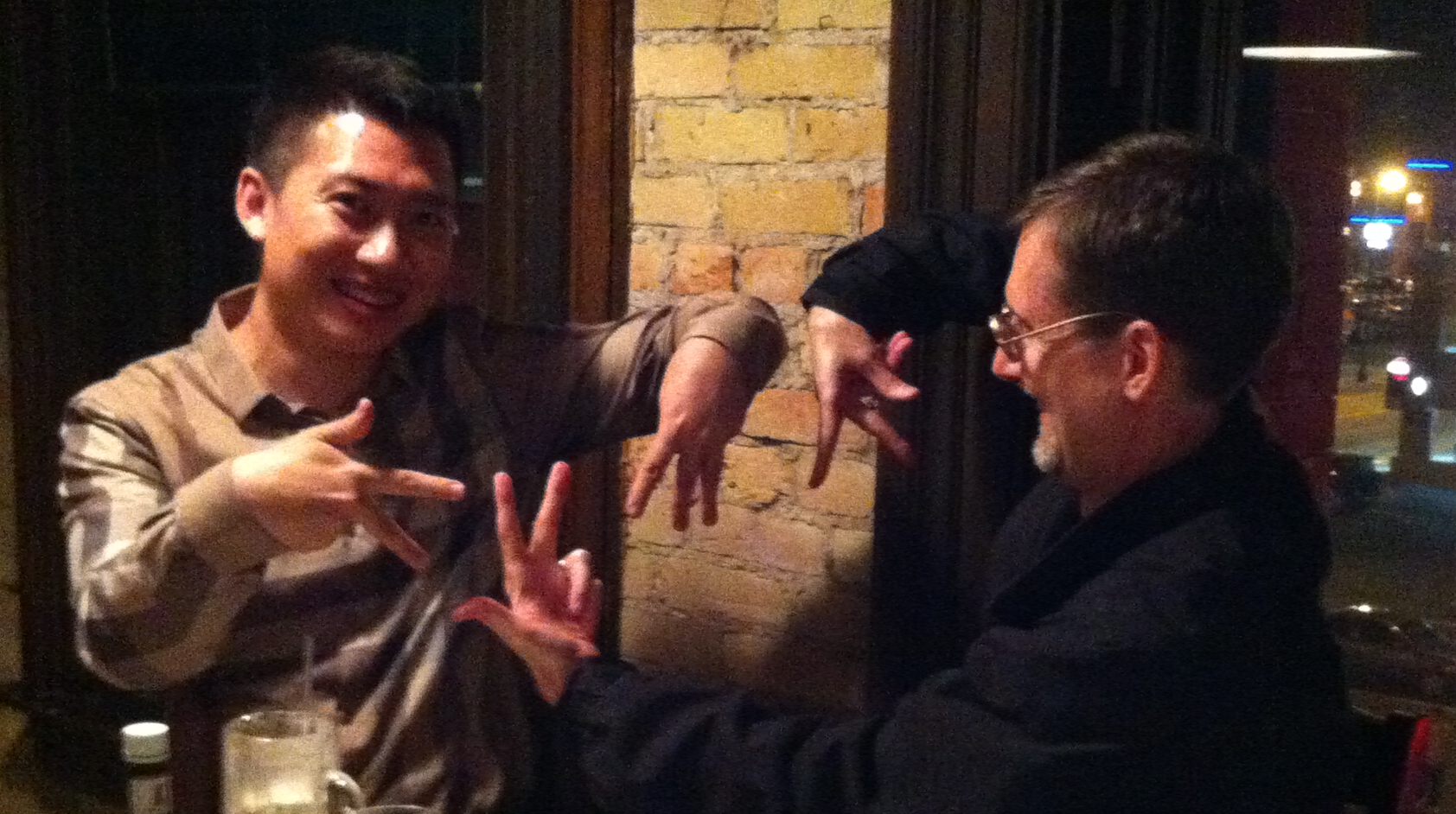
Fascinating papers, lively concerts, entertaining hands-on workshops, and conversations that carried on late into each night made KISS2012, the fourth annual Kyma International Sound Symposium, an inspiring and invigorating experience for all.
The symposium was covered by several local news outlets (click on photos to read the stories):


Here’s a slideshow of photos from the event:
For more details on the event, please see the official KISS2012 site and Kyma Symposium on Facebook.
This is a live recording of Yasuski playing a Theremin along with Kyma controlled from an iPad on August 4, 2012 at Akasaka Red Theater in Tokyo. Â You can always watch what Yasuski is doing right now on his uStream channel.
Supersilent, described as the stylistic intersection of Miles Davis, Tangerine Dream, Sonic Youth and Stockhausen has been collaborating with influential bassist/producer/composer John Paul Jones (Led Zeppelin, Them Crooked Vultures) on a new project that takes the group to a complex and intensely powerful sonic space. The group performed at the Hafensommer Festival in Würzburg on August 1, 2012.  Check out the photo gallery on the official Hafensommer blog (and look for a shot of JPJ, pick in mouth, controlling Kyma from his iPad).
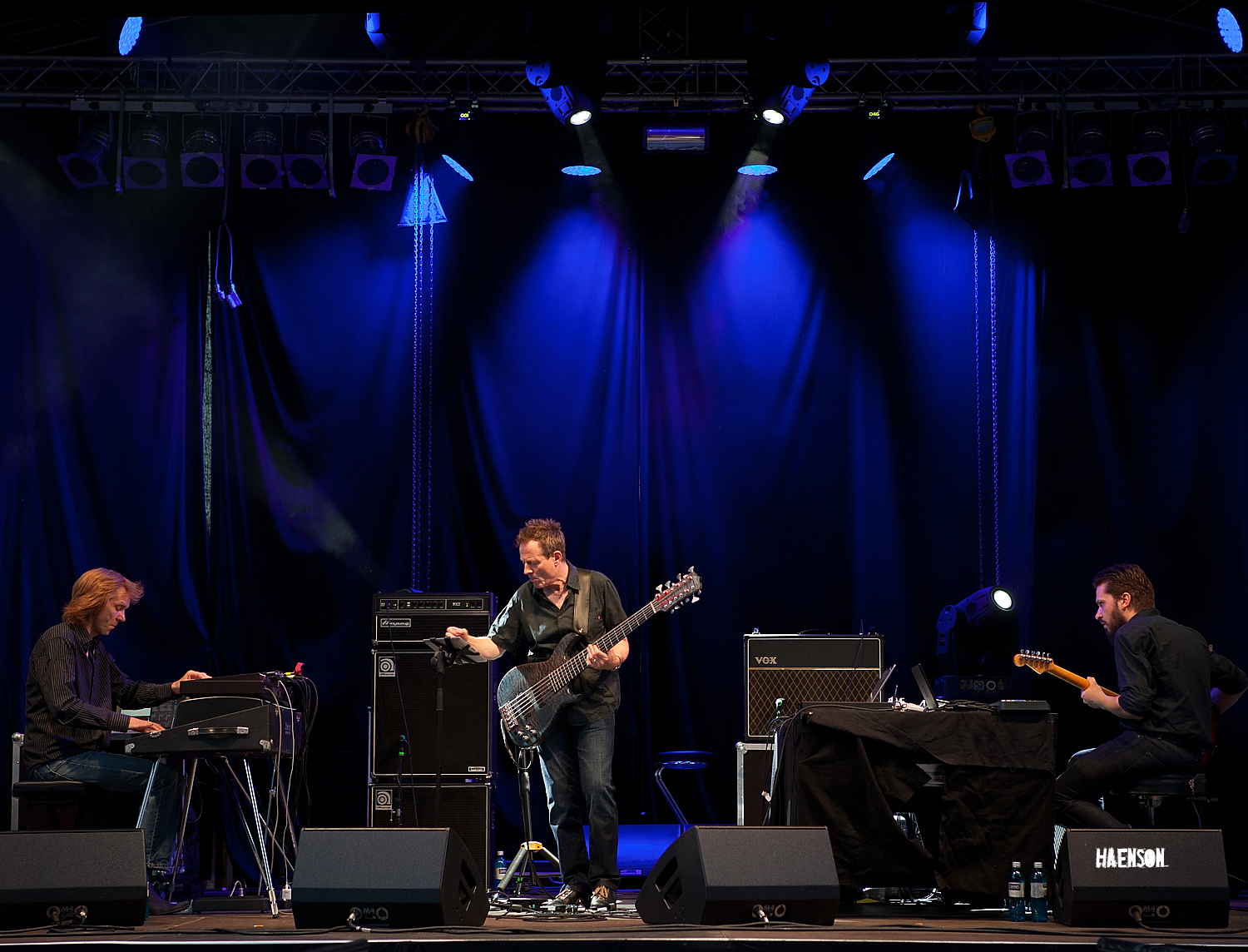
In an interview with the Main Post, JPJ revealed to the interviewers that he had attended kindergarten in Würzburg, so this was something of a homecoming for him.
As critic John Kelman wrote of the collaboration at All About Jazz:
It sounded, in fact, as if they’d been playing together for years, as Jones moved around the neck to create, deep, visceral and snaking lines beneath Sten’s sonic manipulation, Storløkken textural excursions and otherworldly electronic melodism, and Henriksen, who moved from kit to trumpet growl to falsetto and harsher to pocket trumpet (…) All of Which makes Supersilent a unique experience (…) a definitive moment in the history of the festival (…)
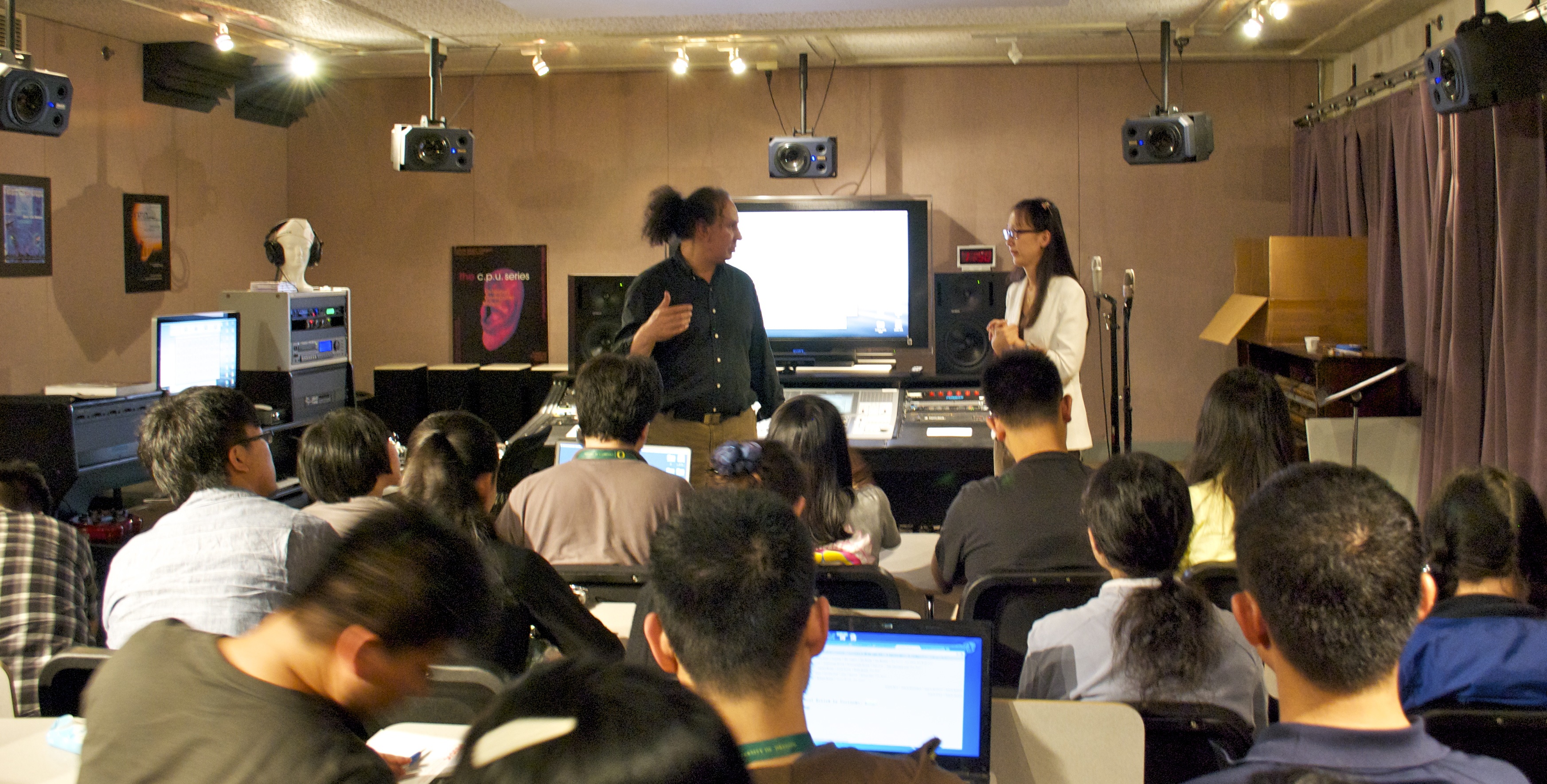
This year’s Summer Academy of Electronic Music, directed by Professor Jeffrey Stolet at Future Music Oregon, welcomed 5 faculty members from the Central Conservatory of Music in Beijing, the Shenyang Conservatory of Music and the Sichuan Conservatory of Music. The faculty members, along with students from their schools and from Peking University and the National Academy of Chinese Theater Arts, immersed themselves in Kyma, recording techniques, sound synthesis, and composition in a two week intensive seminar based on Professor Stolet’s text, Kyma and the SumOfSines Disco Club, now available in both English and Mandarin Chinese.
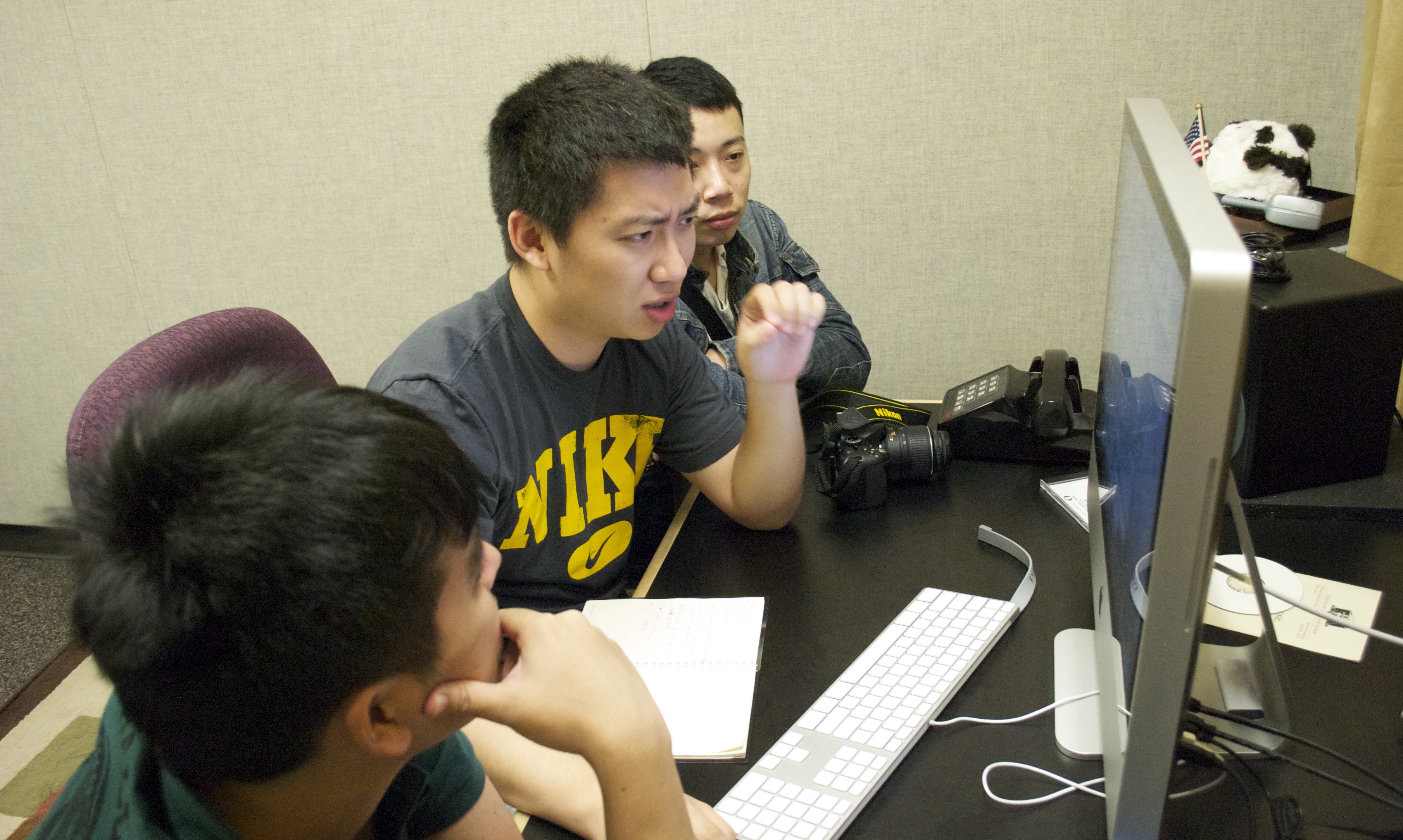
Professor Stolet was assisted this year by three of his current and former graduate students: Chi Wang, Jon Bellona, and Hua Sun (see photo on left).
The Summer Academy culminated in a final concert featuring 20 compositions, all completed by students over the course of the two-week course.
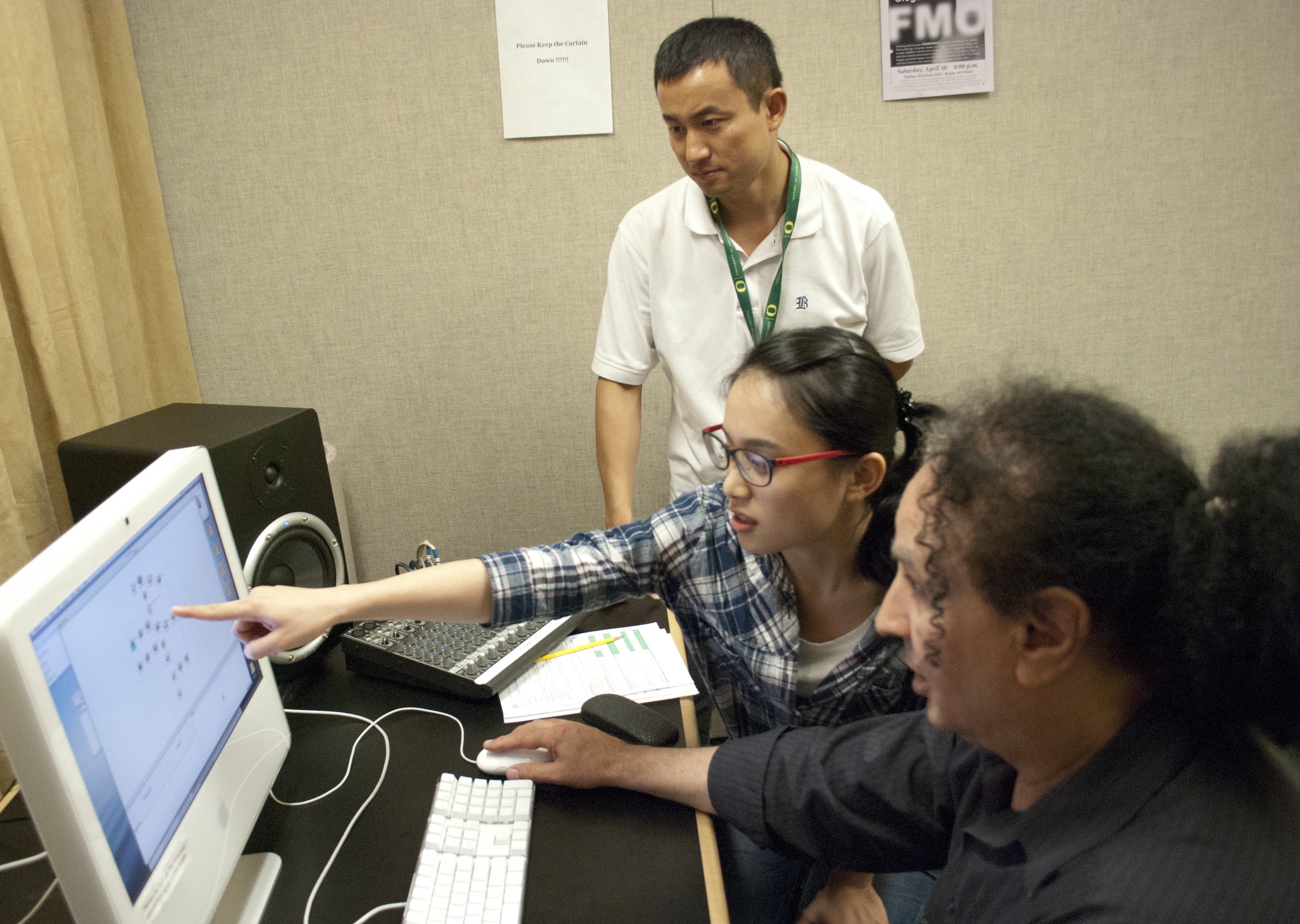
If you missed the summer academy, you still have a chance to learn about Kyma.  During the fall semester 2012, Professor Stolet and his former masters degree student Chi Wang will be presenting Kyma seminars at the Central Conservatory of Music in Beijing, the Shenyang Conservatory of Music and Sichuan Conservatory of Music.

Sound designer Jean-Edouard Miclot has created an amazing Whoosh-Machine, capable of generating hundreds of sonic “whoosh” effects in minutes.  Have a listen!
In his sound design blog, Miclot not only explains how it works, he even provides a copy of the Kyma patch that you can download and try out on your own velocity-thirsty source material:Â http://jedsound.com/blog/?page_id=1020
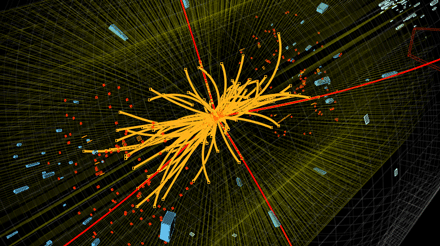
The sound bite works its way backwards in time, starting with the evidence and then gradually inferring the probable cause. At the beginning you hear two distributions, one on the left and one on the right, each with 500 gamma energy values (each gamma distribution is mapped to a 500-partial filterbank); over time, each gamma distribution morphs to a distribution of Higgs masses, all 500 center frequencies converging on the single high energy/mass value mapped to the high pitch at the end. In the middle, the (static) dR and pTt distributions (also represented by 500-partial spectra controlling filterbanks) fade in and out. Over this backdrop you hear some of the explosive and shivery mappings of jet data (see below).
At the very very end, you may hear a hint of an inference of the voice of the Higgs…
Please play it as loud as your speakers can handle (it sounds best with a subwoofer if you have one). The original is in surround sound but a stereo version was easier to post.
Where did this come from?
Experimental and theoretical particle physicists Lily Asquith and Michael Krämer, in addition to their regular research and teaching duties, have been collaborating with musicians this year on a special project to take the data from some of the quadrillions of proton collisions going on in the Large Hadron Collider at CERN and mapping those data sets to sound. Not only are the researchers hoping to hear patterns in the data; they also want to share their passion for exploration and discovery with creative individuals outside of physics.
The project got started last year, when Asquith and composer Richard Dobson created the LHC Sound project, posting sounds and simulated data on the web and inviting musicians to sample the sounds and map the data. Asquith called one of the sets the Jet Game, the object of which was to be able to identify (using only your ears) which of the jets contained evidence of the Higgs boson. Carla Scaletti decided to map several of the jets to sound using Kyma, and the results ended up in the musical score she and Cristian Vogel composed for choreographer Gilles Jobin‘s Spider Galaxies.
At the beginning of this year, Asquith teamed up with Krämer and Scaletti to explore even more ways of mapping data to sound. So far, all the sounds have been generated using simulated data (the real data are top secret), but the trio look forward to having a listen to actual LHC data soon.


Tridecaphiles can celebrate at Cafe OTO with the UK premiere of the Minibus Pimps on Friday July 13, 2012; doors open at 8 pm.  The first event in a new series at Cafe OTO co-curated by Norway’s Ny Musikk organisation and OTO projects will feature the Minibus Pimps – a new collaborative project between legendary UK musician John Paul Jones and prolific Norwegian producer/musician Helge Sten (Deathprod and Supersilent). The pair explore ravishing, intricate noise via a set-up of guitar/bass, Kyma, iPads, and more. The evening will open with an appearance by prepared piano/electronics and percussion duo, Steve Noble and Sebastian Lexer. Tickets are £10 in advance, £12 at the door.
Cafe OTO 18 – 22 Ashwin street Dalston London E8 3DL UK
The fourth annual Kyma International Sound Symposium (KISS2012) — to take place September 13-16 at St Cloud State University School of the Arts in St Cloud, Minnesota — will include over 24 hours of technical sessions presented by Kyma experts, 9 hours of hands-on labs, and evenings filled with live music and live cinema showcasing some of the most outstanding work created in Kyma this year.
Since the inaugural symposium in Barcelona in 2009, KISS attendees around the world have benefited from the extensive technical training, aesthetic inspiration, and opportunities for collaboration that KISS is known to deliver. This year, more than 100 sound designers, composers, performers, filmmakers, game designers, authors, audio engineers, educators, and students are expected to participate in KISS2012.
The dual nature of this year’s theme — reel time || real time — has attracted an incredibly diverse group of people! It’s just a great learning opportunity for everyone involved.
— Scott Miller, professor of music composition at St Cloud State University School of the Arts and host of this year’s KISS.
Throughout the four-day event, sound designers will be able to explore the latest innovations, features, and capabilities of the Kyma Sound Design Language and learn how to optimize their work flow so they can create amazing new sounds for film, games, music and more. Kyma practitioners are invited to bring their own Sounds to the labs where they can work with Kyma developers and fellow Kyma practitioners to enhance their results.
One of our passions is to partner with Kyma users to help bring their creations to life. There is no better way to maximize your Kyma skills and discover new collaborative opportunities than by participating in the Kyma International Sound Symposium.
— Carla Scaletti, president of Symbolic Sound Corporation, co-host of KISS2012.
If you are obsessed with sound — whether a novice seeking to kickstart your career, an expert looking to take your mastery to the next level, or someone who’s simply curious about sound design and Kyma — KISS2012 is your chance to immerse yourself in sound and ideas for four intense and inspiring days and nights.
The deadline for discounted registration is August 10, 2012.

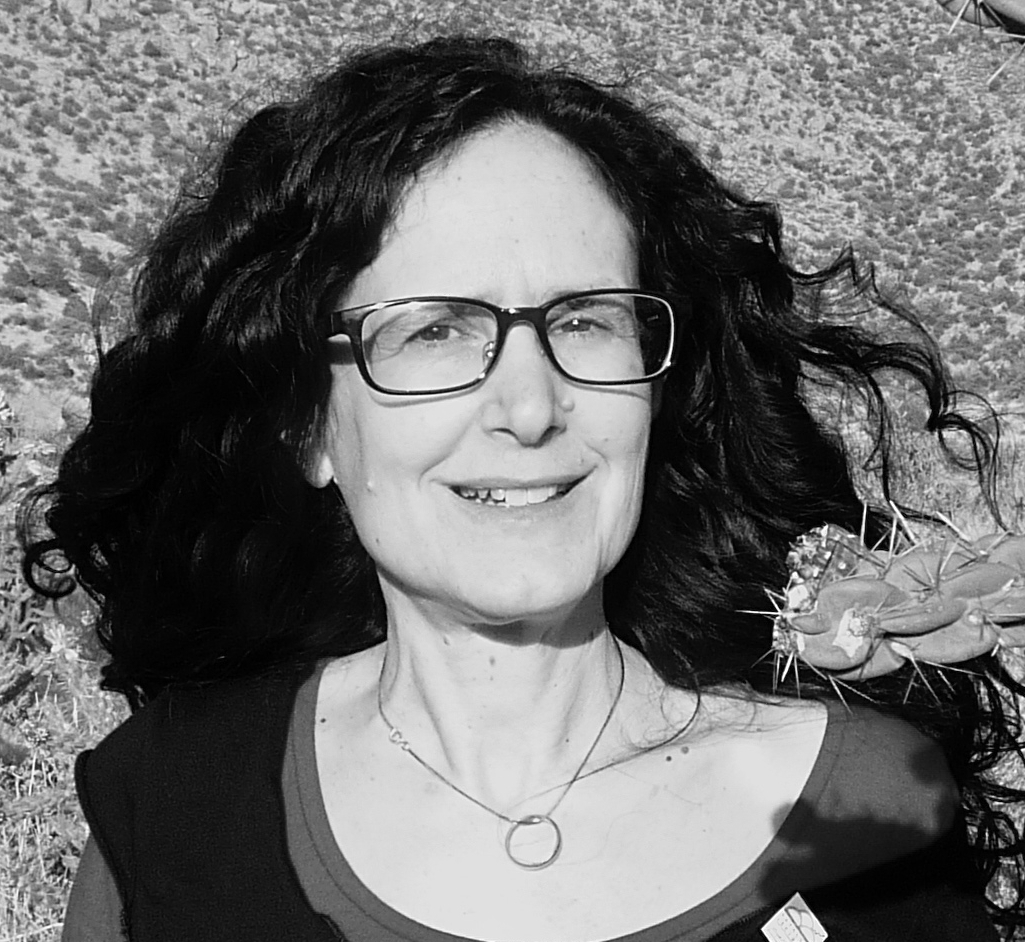 Symbolic Sound President Carla Scaletti will start things off with an introduction to sound design in Kyma and an overview of this year’s theme: ‘reel time || real time’. On the last day, she’ll give attendees a tour of what’s new in Kyma.
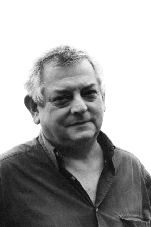 Joel Chadabe, President of Electronic Music Foundation, author of Electric Sound: The Past and Promise of Electronic Music, Adjunct Professor in Music Technology at NYU, has been teaching and composing with Kyma since 1992. In his keynote address, he’ll discuss composition and sound design with Kyma as a learning and discovery experience. In his words:
Kyma is a kit from which you can connect specific components to make an instrument. It’s your instrument. And it does what you want it to do. I’ll talk about designing an instrument and how the design and the nature of interdependent variables, fly-by-wire and dynamic control hierarchies, and interaction affect what you do (and, by the way, what do we mean by ‘interaction’?).
 British composer and sound engineer Greg Hunter is perhaps best known for his production work with The Orb and Youth and as a composer of electronic world music and contributor to the scores for Matrix Reloaded and Matrix Revolutions. Currently writing a book on audio engineering, Greg will share some of the secrets he has learned during his career as remixer and producer:
In the 21st century, the distinction between composer and sound engineer has become very blurred. Most modern composers do not have the time or inclination to become professional sound engineers, yet an understanding of these skills is very important for creating music and designing sound.
More than 30 expert presenters from eight countries will be on hand, among them London-based sound designer and master of morphing Pete Johnston; Mike Johnson, senior sound designer at Blizzard (World of Warcraft-Cataclysm, Diablo III, and others); Rudi Giot, director of the Belgian ISB EEG Brain Computer Interface project; Edmund Eagan, Canadian film composer and Continuum fingerboard virtuoso; Jeffrey Stolet, author of Kyma and the Sum of Sines Disco Club (currently being translated into Mandarin for publication early next year); and many more!
Among the topics to be addressed are:
For a more complete list of expert presenters, performers, and composers, please see the preliminary program.