A Movable Beast

In his role at BEAST (Birmingham Electroacoustic Sound Theatre), Simon Smith works with massive multi-speaker array concert systems on a daily basis. These experiences inspired him to design a system of his own that could generate moving sound sources and immersion without the need to carry around large amps and speakers.

When Smith came across the Minirig loudspeaker — a small Bluetooth speaker typically used for small parties and “annoying people on the beach” — he bought 4 of them and, using standard microphone mounts and gooseneck microphone stands, he started experimenting with various configurations. Initially using tea coasters and cable ties, he eventually found drainpipe mounts that fit the Minirigs perfectly. Now he’s able to flexibly angle the loudspeakers toward nearby reflective surfaces (walls, windows, ceilings, panels), creating an impression of the sound coming from the room and not just the loudspeaker.


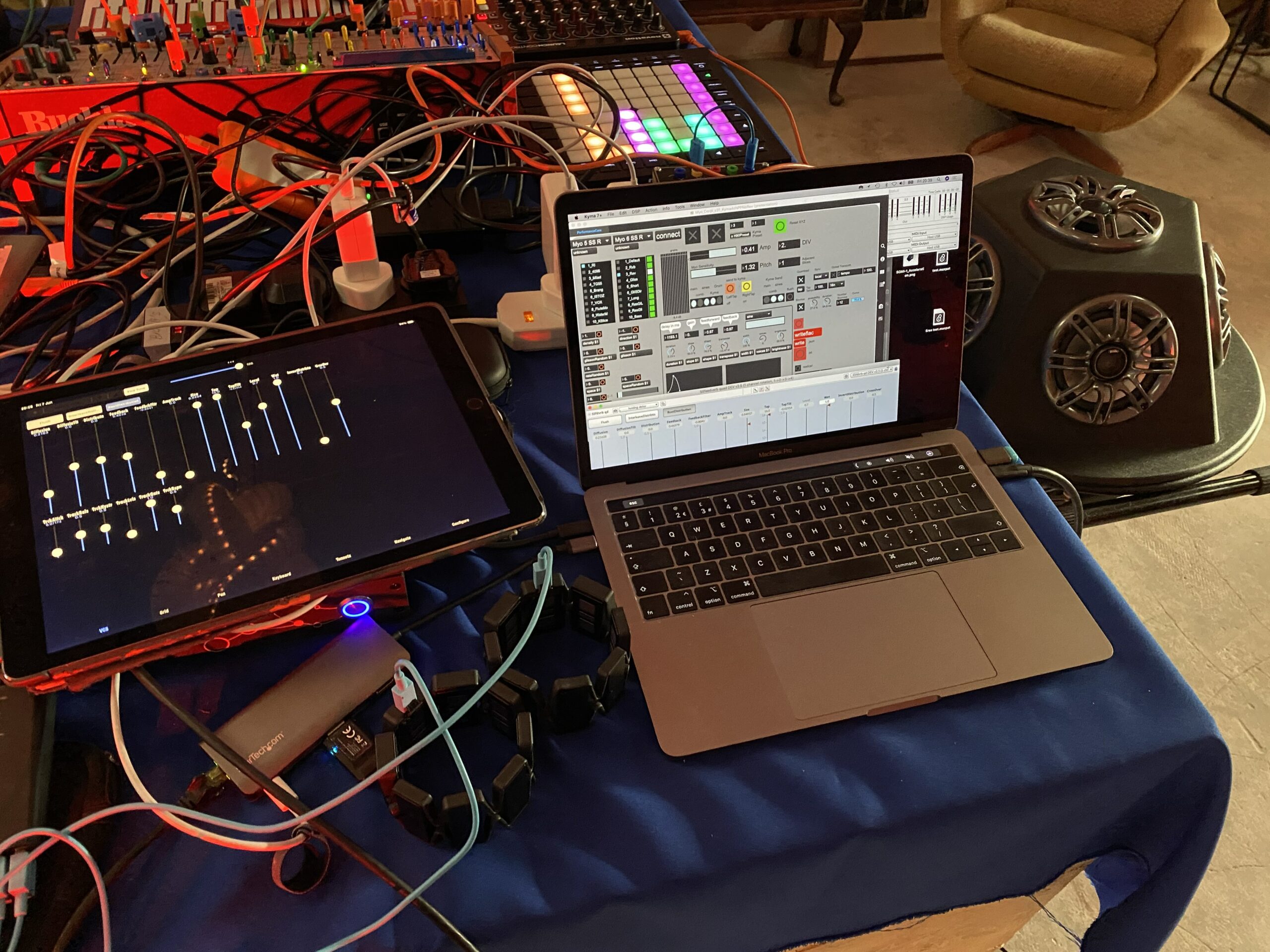
The speakers are just loud enough that he can play along with acoustic instruments without overwhelming them. Smith’s initial setup has now grown to 8 speakers with 2 subs, and by design, the entire rig (Pacamara, Laptop, and Minirigs) can be battery powered, opening the possibility for impromptu off-grid performances in interesting acoustic spaces. He christened his modular sound spatialisation system the Portable Immersive Sound System intentionally, because he knew he was destined to take it places.

During a recent performance at PAN-PAN, Simon used his MYO armbands to control a concatenatenative synthesis patch routed through Kyma (running a custom delay line designed by Alan Jackson and workshopped by the Kyma Kata), then through an Eventide H90 which sent quad out to his portable spatializing speakers.


See you in Seoul

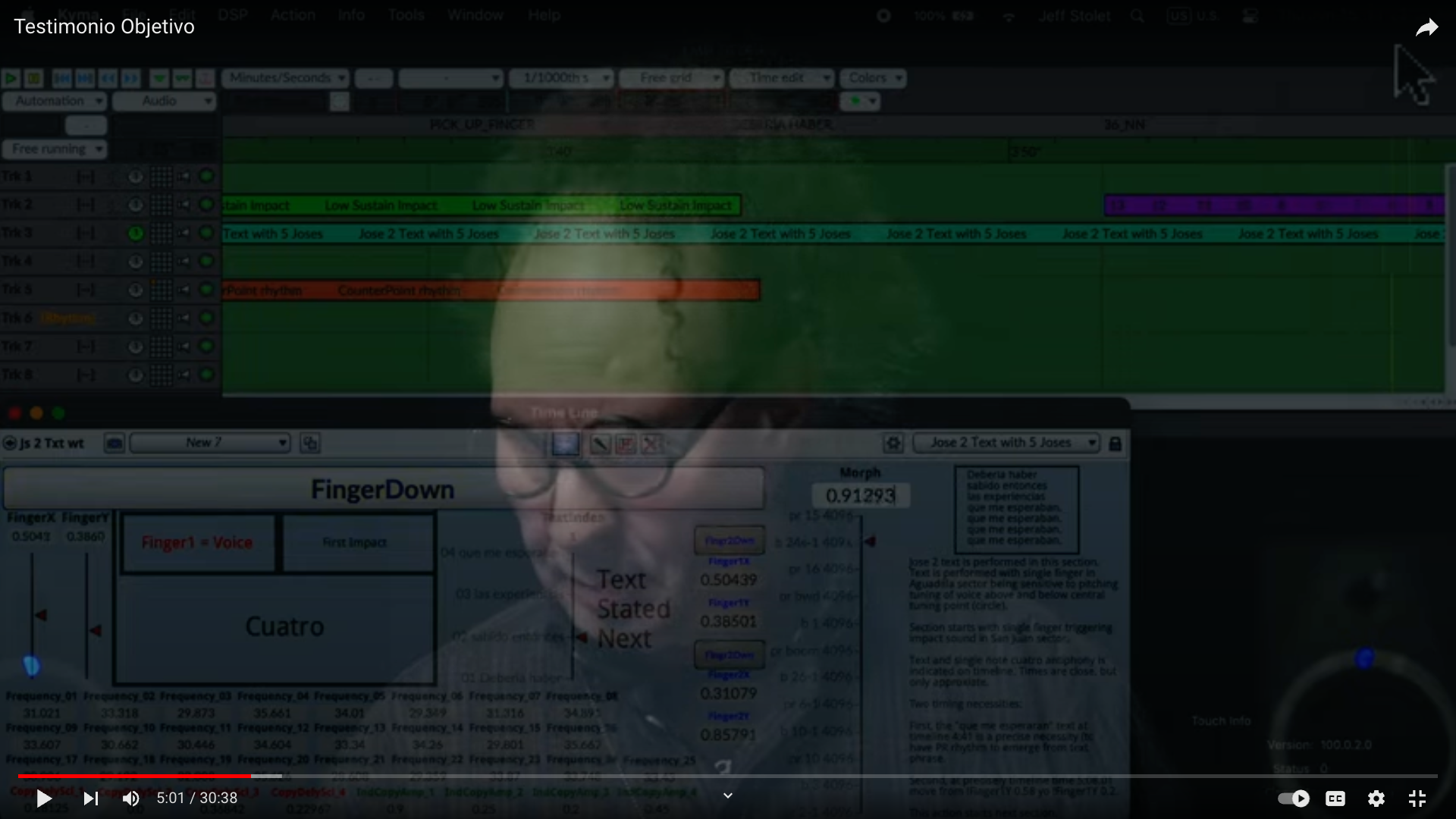
Video frame from a performance of Testimonio Objetivo by composer Jeffrey Stolet

International Computer Music Conference
“Sound in Motion”
7-13 July 2024
https://www.icmc2024.org/

There will be multiple opportunities to connect with fellow Kyma artists during the ICMC 2024 in Seoul, South Korea, where you’ll hear them performing on several concerts and presenting their ideas on paper sessions. Here are just a few of the composers using Kyma who will be participating in the ICMC during the week of 7-13 July 2024:

Shuyu Lin When Dandelion Whistles
Fang Wan Song Yun
Chi Wang Transparent Affordance
Jeffrey Stolet Testimonio objetivo
Oliver Kwapis Lucky
Jinshuo Feng Listening to the Deep: An Interactive Music Exploration of Oceanic Soundscapes and Climate Change
Tao Li 枯山水 Beyond Landscape
Hector Bravo Benard Nowhere

On the paper sessions:

Jeffrey Stolet Music-Centric Description of Performance with Data-Driven Musical Instruments

Run

Run, by Mei-ling Lee, is a journey exploring the depths of fear, uncertainty, and the inevitability of death. Written for voice and double bass processed live through Kyma, the composition confronts our deepest fears about life and death, and contemplates the nature of “letting go.” Through this sonic journey, the composition explores what it means—in the midst of the transitory nature of life—to try to hold on to the ephemeral, the intangible. One aspect of this question might be: do the dead hold on to the world, or is it actually the living who won’t let go?

Tipping Point

As part of the 2024 International Orgelpark Symposium on 7 June 2024, Franz Danksagmüller invited Carla Scaletti to talk about her piece misfold for hyper-organ and Kyma, which was composed specifically for Danksagmüller.

During the round table wrap up on the final day of the conference, Randall Harlow described misfold as an example of “music for and of our time”

Here’s a performance of misfold recorded by Franz Danksagmüller at St. Nikolai Kirche in Hamburg earlier this year.

La Berge and friends

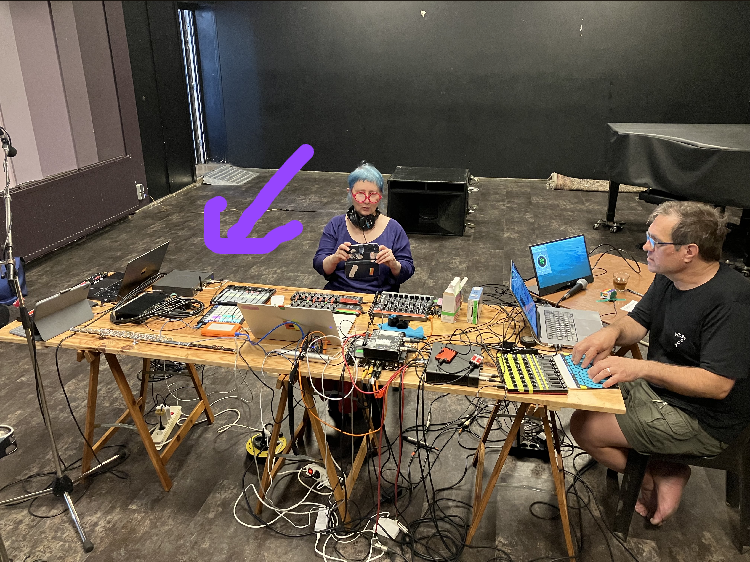
Anne La Berge posted a photo of her live performance setup for the Tell me more concert at Splendor in Amsterdam, 29 June 2024, featuring her flute processed through Kyma controlled by Continuum mini, iPad and enhanced by a hand-cranked siren:

La Berge had performances throughout the month of June:

Saturday 15 June: The Day of the Composer in The Netherlands
Ensemble Oihua performed La Berge’s composition RAW as part of a varied program at the Batavierhuis in Rotterdam (La Berge performed with them).
Pieter de Hoochweg 108, Rotterdam


Wednesday 26 June
Anne Wellmer, Matt Rogalsky and Anne La Berge (not pictured, but her flute, Pacamara, laptop, Continuum mini controller, and iPad are on the left edge of the table)
Performance with electronics, objects, instruments and inventive musical friendliness.
Zaal 100, De Wittenstraat 100

Saturday 29 June: Tell Me More
Anne La Berge performed a new version of Up Until Now, using old and new material all in one breath as the story of her life.
Splendor Amsterdam, Nieuwe Uilenburgerstraat 116

Leaving a trace…

Composer Tom Williams used Kyma to extensively transform the sonic materials in his 2023 acousmatic composition Piano Trace, performed at multiple festivals including Jauna Muzika 2023 in Vilnius, Noisefloor 2024 in Lisbon; Spatial Audio Gathering, DMU, Leicester; NYCEMF2024, New York. Williams, who has a doctorate in music composition from Boston University, currently heads the Music Production MA program at Coventry University.

Piano Trace is conceived as an unfolding of trace material that marks its original source: soundings made on an upright piano. Williams writes:

This is my piano. The piano that has been by my side as a tool for composition but never, until now, the actual source of my composition. A pocketful of playful recordings from the soundboard, piano keys, pedals and strings are the sonic roots. Throughout, and within the transformations and messing-up of the source sounds, there lies an inherent trace, a timbral DNA, a semblance of sonic integrity that is the ephemeral body of Piano Trace.

Kyma update features enhancements to interface

The newest update to Kyma (7.42f5) features improvements to the interface and several handy new features including:

    • For more accurate placement of Sounds during drag-and-drop, the cursor changes to a cross-hairs with transparent center plus corners during dragging.
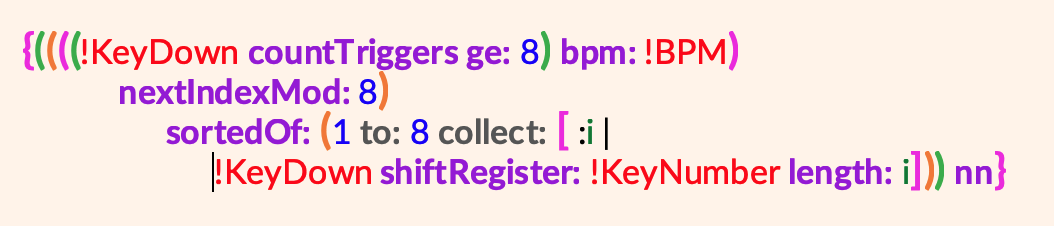
    • Enhanced syntax coloring matches the colors of corresponding pairs of open/close brackets and parentheses.

    • Cleaner signal flow diagrams, thanks to an option to hide Constant Zero shared Sounds in Replicators (Edit menu > Settings > Appearance)
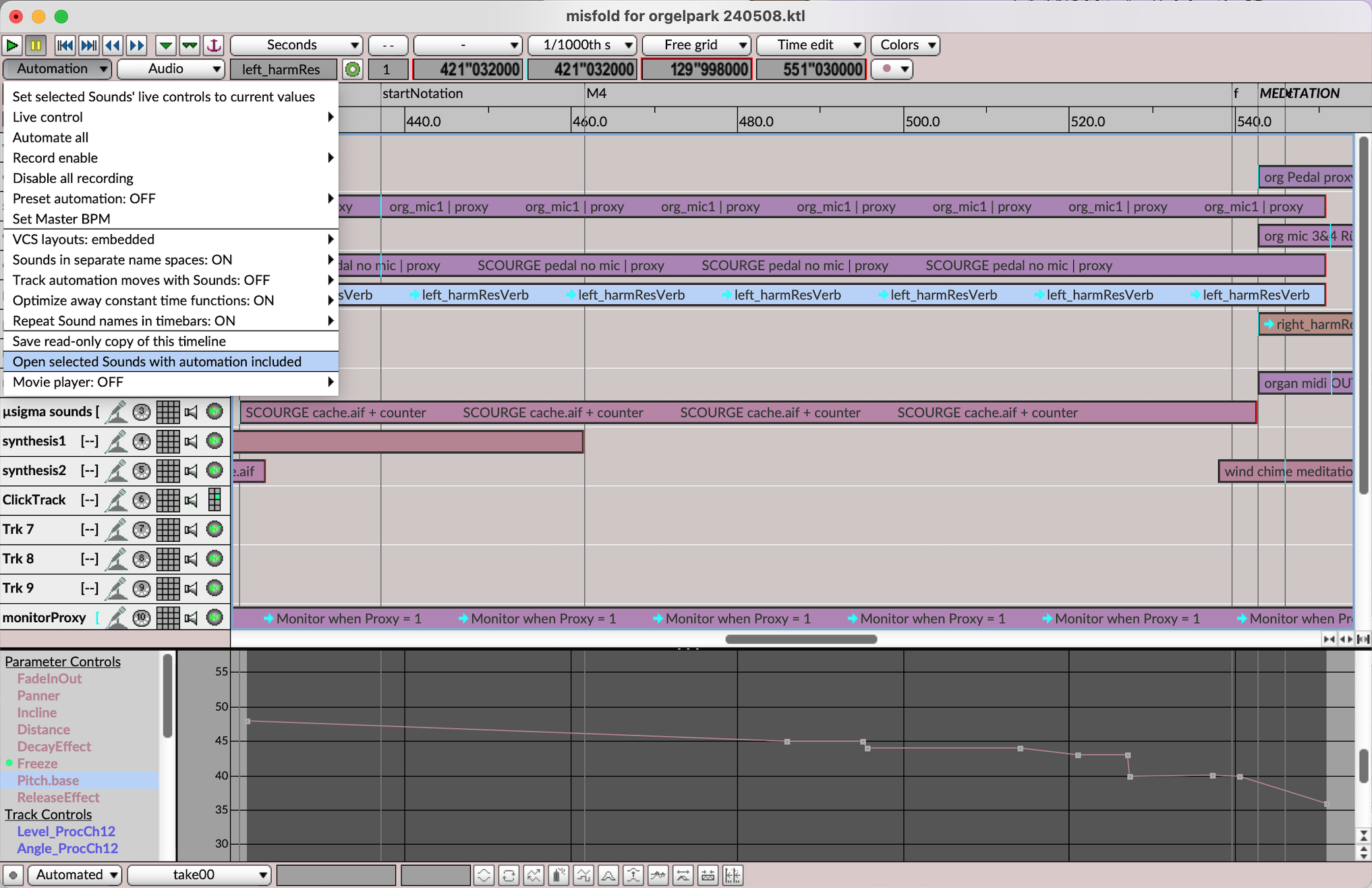
    • New option to open a Sound with a MapEventValues for mapping the parameter automation functions from the bottom of the Timeline, so you can hear the Sound on its own with the same settings it has in the context of the Timeline with those parameters automated.

  • There’s a new keyboard shortcut for unlocking the VCS for editing. Cmd+T (mnemonic TRANSFORM VCS or Turn-on the editor) that is equivalent to Action menu > Edit VCS layout

As well as multiple other fixes and enhancement requests from the Kyma community (thank you for your reports and feedback!)

The new update is free, and you can download it from the Help menu in Kyma.

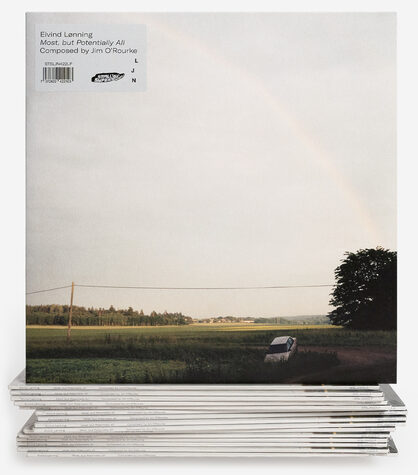
Most, but potentially all Composed by Jim O’Rourke

Jim O’Rourke & Eivind Lønning on Boomkat (Artwork, Blank Blank)

 
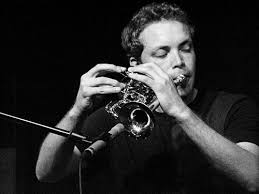
Longtime collaborators trumpeter Eivind Lønning and composer Jim O’Rourke have just released an intoxicating new album on Boomkat: Most, but potentially all Composed by Jim O’Rourke.

Lønning provides exquisite acoustic trumpet sounds and O’Rourke’s Kyma transformations, described by Boomkat as “often gentle and illusory, and sometimes utterly lacerating – lift the sounds into completely new territory.”

The entire album was composed, mixed and mastered by O’Rourke and is based solely on material from Lønning’s virtuosic performance.

Trumpet virtuoso Eivind Lønning


In the words of the Boomkat reviewer, it’s a “piece that shifts the dial on contemporary experimental music; dizzyingly complex but never showy, it’s the kind of record you can spin repeatedly and hear something different each time… as a progression of electro-acoustic compositional techniques, it draws a deep trench in the sand, setting a new standard.”

Lønning is touring with the material starting with a 29 May 29 2024 concert at the Edvard Munch museum.

Data sonification for scientific exploration & discovery

Data sonification, often used for outreach, education and accessibility, is also an effective tool for scientific exploration and discovery!

Working from the Lindorff-Larsen et al Science (2011) atomic-level molecular dynamics simulation of multiple folding and unfolding events in the WW domain, we heard (and analytically confirmed) correlations between hydrogen bond dynamics and the speed of a protein (un)folding transition.

The results were published this week in The Proceedings of the National Academy of Sciences (PNAS), vol. 121 no. 22, 28 May 2024: “Hydrogen bonding heterogeneity correlates with protein folding transition state passage time as revealed by data sonification”

Congratulations to everyone in the Biophysics Sonification Group:

Carla Scaletti (1), Premila P. Samuel Russell (2), Kurt J. Hebel (1), Meredith M. Rickard (2), Mayank Boob (2), Franz Danksagmüller (9), Stephen A. Taylor (7), Taras V. Pogorelov (2,3,4,5,6), and Martin Gruebele (2,3,5,8)

(1) Symbolic Sound Corporation, Champaign, IL 61820, United States;
(2) Department of Chemistry, University of Illinois Urbana-Champaign, IL 61801, United States;
(3) Center for Biophysics and Quantitative Biology, University of Illinois Urbana-Champaign, IL 61801, United States;
(4) School of Chemical Sciences, University of Illinois Urbana-Champaign, IL 61801, United States;
(5) Beckman Institute for Advanced Science and Technology, University of Illinois Urbana-Champaign, IL 61801, United States;
(6) National Center for Supercomputer Applications, University of Illinois Urbana-Champaign, IL 61801, United States;
(7) School of Music, University of Illinois Urbana-Champaign, IL 61801, United States;
(8) Department of Physics, University of Illinois Urbana-Champaign, IL 61801, United States;
(9) Musikhochschule Lübeck, 23552 Lübeck, Germany